a little bird told me………

blueprint for the arts

August 10, 2009 · Leave a Comment

Every decade or so, there is a new blueprint for the arts. It’s not always clear whether the blueprint is the initiative of the current arts administration or the politicians in charge, whether it is a genuine attempt to improve things, an electioneering ploy or simply an expression of the current administration’s vanity. Some people will view blueprints with cynicism but for art enthusiasts hungry to propel arts into the mainstream, it is always a welcome platform to talk about the arts and inject a fresh impetus and resolve to advance arts development further.

The 1980s blueprint for the arts was enshrined in the 1989 “Report of the Advisory Council for Culture & the Arts”.  The ACCA Report was literally a “blueprint”. We chose blue for its cover.

ACCA Report: a literal "blueprint" for the arts

ACCA Report: a literal "blueprint" for the arts

In Feb 87, the Singapore Government announced its Green Paper & “Agenda for Action” outlining the course for Singapore as we moved towards 1999.  ACCA was set up on 9 Apr 88, to “review the current state of the arts and culture, and to recommend measures that will make Singapore a culturally vibrant society by the turn of the century”.  It was one of six Advisory Committees coordinated by the office of the 1st Deputy Prime Minister Goh Chok Tong, reviewing various aspects of Singapore life including the arts, education, health, heritage and social services.

2nd Deputy Prime Minister DPM Ong Teng Cheong chaired the ACCA and its members were Arun Mahiznan, Chia Kee Koon (Ministry of Finance), Er Kwong Wah (Education), Hawazi Daipi (Berita Harian), Ho Kwong Ping, Koh Cher Siang (Permanent Secretary (MCD), Leslie Fong (Straits Times), Loy Teck Juan (Lianhe Zaobao), Prof Edwin Thumboo, Robert Iau, Haji Suhaimi Jais (SBC), Tay Kheng Soon, Mrs Wong-Lee Siok Tin (GM/Singapore Broadcasting Corporation), Yeo Seng Teck (Trade Development Board) and Vincent Yip (ED/Science Council). ACCA members chaired its Committees on Heritage (Tay Kheng Soon), Literary Arts (Prof Thumboo), Performing Arts (Robert Iau), Visual Arts (Yeo Seng Teck) and a Working Group on a “New Cultural Development Agency” (Arun Mahiznan). Ministry of Community Development manned the Secretariat for ACCA with Ng Yew Kang and me as Secretary and Assistant Secretary respectively.

The ACCA met eleven times between Apr 88 and Apr 89 while its committees, 25 subcommittees and working groups met 129 times. Over 200 people including artists, art promoters and historians were involved while 150 written submissions were received from the public. 

The key ACCA recommendations that have materialised include the establishment of the “[Singapore] National Arts Council”, the [Singapore] National Heritage Board [Trust]”, the construction of a new performing art centre at Marina Centre, a modern National Library building on Queen’s Street, and a Fine Arts Gallery in St Joseph’s Institution. The recommendation to allow students to offer Dance, Creative Writing and Theatre Studies has found fruition with the recent set-up of the School of the Arts (SOTA). ACCA also validated the initiatives we introduced earlier including the Theatre Residency Scheme, the Arts Housing Scheme and the conversion of SJI into an art museum.

The recommendations that have not materialised are the establishment of a Children’s Museum (Tao Nan School has been used for the Asian Civilisations Museum), a Literature Board, a Southeast Asian / Natural History / Ethnology Museum, a sculpture park on the Bras Basah Park on which now stands the Singapore Management University. I am not sure about the History of Singapore Museum. There are components of Singapore history in the new “National Museum” but it has become better known for European fashion design exhibitions, art films and touristy events like the Night Festival. I wonder where we can find galleries on important personages like the late S Rajaratnam and EW Barker. I saw an excellent (I’m told “temporary”) exhibition on the late David Marshall in the National Library a few months ago and hope such informative exhibitions will find it way into a full-fledged History Museum eventually.

ACCA gave me the privilege of working once again with DPM Ong. I worked with him in 1975 as a young Administrative Officer in the Ministry of Communications to which he was first posted as Minister. I worked with him again when I became the General Manager of the Singapore Arts Centre Company Limited from 1992 to 97. Mr Ong’s passion for the arts was manifest through his various appointments.  I can’t help thinking of him as the most significant prime mover for the arts in Singapore, having put into place all the essential building blocks - festivals, foundation, awards, the NTUC Cultural Unit and of course, his magnus opus, The Esplanade Theatres.

All the key papers deliberated by ACCA were penned by civil servants including Ng Yew Kang and I who wrote many of them. I sometimes wonder how different it would be were the papers penned by non civil servants. Would the course of arts development taken a different turn?  After all, the value of non-Government ACCA members was to offer a perspective different from us civil servants.

→ Leave a CommentCategories: Ministry of Community Development (1985 to 1990)

from “organizer” to “arts administrator”

August 8, 2009 · 2 Comments

The Straits Times article “Wanted: More leaders in the arts industry” (2 Aug 09), prompts me to reflect on how far we have come.  In two respects;  first, how the term “arts administrator” rolls off the media tongue with such fluency; and second, that there is actually public concern about the dearth of arts administrators.

In the early 1980s, staff in the Cultural Affairs Division were designated “Organiser”. There were five organisers including Lim Mee Lian who was Organizer (Music) and Chua Ai Liang, the Organizer (Drama).

The very first Arts Administration courses in Singapore were held from 14 to 30 Aug 85.  They were conducted by Harmon Greenblatt and Irene Conley from the Department of Arts, Entertainment and Media Management, Columbia College, Chicago, Illinois which was reputed to have the largest arts administration programme in the United States at the time.

P1000613

Thank You note from Harmon & Irene

Two three-week courses were conducted concurrently, in the afternoons for staff from the public sector including the Ministry of Community Development, National Theatre Trust, SSO, SBC and STPB; and in the evenings for staff from the arts groups, art schools and arts entertainment agencies. Course content was wisely worked around a list of topics offered by the participants to ensure relevancy to their situations; and included topics like the formulation of arts policy, arts marketing & ticket pricing, fund-raising, programming and production.

Apart from taking comfort in the realisation that their funding problems were universal in nature and the chance to form new alliances within the local arts community, participants came away with a sense of belonging to a global community of professional arts administrators.  We celebrated when a month or so after the courses, the media began to use the term “arts administrator” and ”arts manager” instead of “organiser”.

I have always wondered what makes a good arts administrator.  Must one be an arts practitioner?  Would artists make good arts administrators? Is a little arts knowledge a good or bad thing? Must one be a good entrepreneur or marketer? Must one be creative? Must one have worked in “grassroot” organizations? What about the gift of the gab? and do strong networks and connections count?

INMO, first, a good arts administrator must love the arts to bits, not do the job because of the glamour it attracts. After all, the glamour is simply a spin we devised to attract glamorous brands to become sponsors. Second, they must truly and wholeheartedly aspire for ordinary persons to express themselves aesthetically or experience artistry daily, not only on entering an artifice called a “theatre”.  It is not about making available or ”imposing” on the man-in-the-street, types of arts that the arts administrators themselves favour especially if he or she is still Eurocentric in outlook.  Third, they need to balance artistic and business considerations in ingenious ways, which may necessitate sacrificing high salaries as every dollar going to salaries is one less for artistic pursuits.

On the one hand, I believe that artists and arts administrators must be paid a respectable salary for the important work they are doing – defining a society’s identity and what Minister George Yeo beautifully described as “edifying the human spirit”.  On the other hand, a good salary cannot be the chief motivator for arts administration as a choice of career.  This is a paradox that reminds me that when Brother McNally beckoned me to La Salle College of the Arts in 1997 (when we met at the ACM opening after I had just joined Singapore Pools) offering to pay me anything I wanted, I replied that I knew La Salle could not afford a salary for a single mother supporting two school-going children and that if I accepted his offer of a large salary, it would negate my passion / sense of nobility in accepting the job.

Leading lights Alvin Tan (TNS), Chong Tze Chien (Finger Players), Ekachai (Action Theatre), Ivan Heng (W!ld Rice), Ong Ken Sen & Tay Tong (TheatreWorks) and Ruby Lim-Yang (Act 3) are quite amazing and I watch them with great admiration. Not only do these arts practitioners love the arts to bits, they sacrificed more lucrative alternative careers for their passion and after so many years, continue to produce oeuvres of works that aptly capture the Singapore spirit.  To top it off, the companies they lead have built and managed their modest reserves and cash-flow to allow their companies the financial security to plan productions 2-3 years ahead.

So I say, “There are brilliant arts administrators aplenty in Singapore”.  This may suggest that it is unnecessary to import “talents” from outside the arts industry or overseas but then again, perhaps, it’s  best we leave them be in the arts community to do the real and more important work that arts policy makers  are supposed to create the enabling conditions for.   Just give them a bigger say on arts policy and developmental strategies which should benefit from the freshness of their years of experience.

→ 2 CommentsCategories: Ministry of Community Development (1985 to 1990)
Tagged: , , , , , ,

heritage festivals

July 28, 2009 · Leave a Comment

SHW86(3)

The not-so-recent redevelopment of Clarke Quay flushed out dealers of memorabilia who have sinced moved to the 2nd storey of China Square.  Browsing through the boxes of postcards, report books and other such homely items last  weekend brought back memories of the first Singapore Heritage Week that we organised in 1986.  

I was then working in a newly- founded MCD with policy “oversight” of the National Library and three heritage departments – National Museum, National Archives and Oral History Department.  

The idea for Singapore Heritage Week was hatched quite accidentally at one of our monthly meetings where we freely exchanged views on the plans and challenges of the departments.    The acquisition budget for the heritage departments was very limited, much much smaller than it is today.  At one meeting, when we were commiserating over the budgetary constraints to enriching our exhibitions, someone – I think it was either Lim Guan Hock (National Archives) or Tan Beng Luan (Oral History Department) – pointed out with urgency that families relocating from kampongs and shophouses to high-rise flats were nonchalantly and rapidly discarding their antiques and memoribilia.   

Brainstorming how we could ”intercept” such “discards” for the benefit of our national heritage collection, we stumbled upon the idea of a high-profile heritage event to alert these families to the historical significance of their personal items and that the heritage departments would like to have them if they no longer wanted them. 


SHW86 Bookmark

SHW86 Bookmark

After a few months of preparation,  the 1st Singapore Heritage Week was held from 4 – 11 Oct 1986.   It was launched by Political Secretary /MCD Zulklifi Mohammed as  he ceremoniously released colourful balloons into the ceiling of the National Museum rotunda with a swift sweep of his antique kris.  All week long, the Museum grounds were dotted by 1950-style itinerant hawkers’ pushcarts selling the foods (eg dragon candy), games (gasing, rice dough puppets) of yesteryears.  In the museum, we staged an exhibition of everyday objects, our way of reminding viewers that they were important purveyors of our social history. 

The Week’s slogan which I must take responsibility and, credit for, was “Your Junk could be our National Treasure.  Thank you for sharing it with us.”  Nearly  everyone – our sponsor, American Express Foundation, our advertising agency and many of my committee members,  felt it was too insulting an

Slogan for SHW 1986

Slogan for SHW 1986

d would not be well-received by the general public.  Barry Arnold who then headed the AMEX team stuck his neck out and agreed that we could take a chance with it. 

We were more than amply rewarded when on our “Walk-In Donation Day” that Sunday, a never-ending queue of ordinary folks streamed into the Rotunda to offer us  their “junk”.  I remember uncles and aunties asking shyly if this or that “would do”  or “was acceptable”.   Beng Luan, Guan Hock, Susie Koay and their colleagues had a field day as they sifted happily through the many objects that fell into our laps.  By the end of Heritage Week, the public had donated over 900 items including complete sets of Chinese classics, porcelain steamboat, World War Two ration cards and many other interesting personal items.

The following week, a member of the public sent a letter to Minister Wong Kan Seng complaining that we had undermined the standard of public hygene by bringing back squalid old carts.  Slightly amused and happy to receive this back-handed compliment, we explained that we had  deliberately stained the newly-constructed carts,  to make them look old and authentic.

I organised two other Singapore Heritage Weeks subsequently and since then, it has morphed into a Heritage Weekend, Heritage Day and now, a fortnight-long Heritage Fest organised by my friend Jeremiah Choy and his company OrangeDot.

→ Leave a CommentCategories: Ministry of Community Development (1985 to 1990)
Tagged: , , , ,

from society to non-profit company

July 27, 2009 · Leave a Comment

Recently-retired NAC Deputy Director Lim Mee Lian who worked with me in the early 1980s as Organiser (Music Programmes) remarked a while ago that these days, anyone starting a new arts group would opt for the status of “company limited by guarantee”.  No one would apply for “society” status these days.

This wasn’t always the case! 

In the early 80s, nearly all the arts groups were societies and the Ministry’s grant scheme stated that only societies were eligible for its project grants, which were extended for events on an ad hoc basis.  However, when we introduced the annual grant scheme in 1985/6, we found the status of “society” rather disadvantageous.  Art society leaders would say “How can I commit us to an 18-24 months plan of activity when I am not even sure I will still be in charge after the next AGM?”  To the best of my recollection, bickering was not rampant in the arts community although it affected one or two groups.  Nonetheless, we knew that frequent changes to a society’s leadership would not offer a stable enough existence to plan ahead and take advantage of the annual grant, SRSITS and Arts Housing Scheme which were devised to nudge groups into professionalism.

After some research and an appreciation of the legalities, we nudged the art societies to convert into “companies limited by guarantee”. They also needed to apply to become “Institute of Public Character” to enable them to offer tax exempt receipts on donations received and “Charity” status to enjoy income tax exemption. The idea was not new but it struck us one day that there was no reason why the arrangement enjoyed by the SSO could not be tapped by the other groups.  We simply transplanted the idea!

Such “limited by guarantee” companies would typically be founded by two or three equally-committed and compatible individuals who shared a common artistic vision, who needed to put out only a modest capital of their choice, hence, the term “$2 dollar company”.  “Limited by guarantee” companies were soon set up by Goh Soo Khim and Anthony Then (Singapore Dance Theatre), Kuo Pao Kun and Goh Lay Kuan (Practice Performing Arts Company) with many others following suit. TheatreWorks, which started as a “private limited” company, also decided to convert to “company limited by guarantee” status.

In line with this change, at the Ministry’s end, we tweaked the criteria for our schemes to allow companies limited by guarantee to enjoy access to them.  So, such companies enjoyed the best of all worlds – the much-valued organisational stability and access to annual and project grants, the SRSITS and Arts Housing Scheme, all of which demanded an organisational and financial stability and continuity; income tax exemption and the facility to offer tax exempt receipts on donations. Directors of such companies would not earn dividends as all operating surpluses would be ploughed back into the company but we did not prohibit them from earning a salary as artistic directors or company managers.

The only downside they had to contend with was that such companies could not get bank loans to pay for major productions or renovation works. Years later, in the 1990s, at a NAC Cultural Plan meeting, I suggested to NAC to front a bank loan on behalf of art companies, to tide them over in deserving situations, but I’m not sure they saw the merit in the idea.  Thankfully, committed, well-heeled board members of some of the art companies have secured credit lines on their company’s behalf.

In the late 1990s when I started to administer the Singapore Pools donation programme for charity and sports groups, I cross-pollinated the ideas for the annual arts grant scheme and SRSITS  to hatch a system of annual grants for the national sports associations, uniformed groups and for grassroots organisations (“SPIN” for “Singapore Pools in the Neighbourhood”) under which we ”bartered” an annual donation for an annual calendar of four events. 

It was déjà vu for me to watch some of the sports associations in turmoil as executive committees got overthrown at AGMs.  I wondered if it would be appropriate for them to consider conversion to “companies limited by guarantee” but despite the big difference that it had made to the arts landscape over the then ten (now >20) years, I realised that this was somebody else’s call to make!

→ Leave a CommentCategories: Ministry of Community Development (1985 to 1990)

theatre residency scheme; 18 “army daze”

July 11, 2009 · 1 Comment

At the Gala Performance of  Wild Rice’s “On Time, On Target” held on Friday, 10 July 09, Wild Rice Artistic Director Ivan Heng harked back to the year 1987 when he played the very memorable Recruit Malcolm in a landmark play named “Army Daze”.

“Army Daze” written by Michael Chiang, was staged by TheatreWorks 18 times(!)  in 1987 under what we clumsily called the “Semi-Residential Status in Theatres Scheme” (SRSITS, in short). 

Several ideas gave rise to the scheme.  We noted that in England and Europe, theatres were dedicated and customized to the needs of specific art companies such as the National Theatre, the London Philharmonic and the Berlin Philharmonic.  At the same too, we noted that the local pattern of theatre usage was inefficient.  As many days were wasted on changeovers as was used to stage performances due to the typical “bump-in + 2 performances + bump-out” pattern.   Furthermore, theatre rentals ate up about 20% of show production budget, making the Ministry’s grants meaningless as the groups were merely “refunding” it in the form of theatre rentals.

While the SSO had been given exclusive of the Victoria Concert Hall in 1978, we did not feel ready to hand any of the other theatres over for the exclusive use of any particular group.  Theatre time was a precious and limited resource and all groups should have equal access to it and we could expect criticisms from the community if we treated any group specially.  However, a theatre housing scheme that enabled a theatre to be shared by a few groups, might be acceptable.  Hence, the term “semi-residential” in two senses, that groups would share a theatre and, none would be housed in it on daily basis.

Work on SRSITS started in the second half of 1986 when we invited arts groups to apply for semi-residential status in the Government theatres. Groups would be selected on the basis of their artistic standard, track record and compatibility with the theatre facility. In exchange for the privilege of priority-booking up to 12 rent-free performing days a year (with adequate rehearsal and sessions), a group had to produce four productions (at least three performances each), to be staged on a quarterly basis around the year. Half of the productions should be new works, preferably Singaporean in origin and the group should attain at least 75% house at these “paid” shows. The groups could apply for Ministry and Foundation grants and space under the Arts Housing Scheme. Theatre staff was encouraged to extend all possible assistance to the groups including clerical and technical assistance without the usual overtime charges.  A case was made out to the Ministry of Finance later to exempt them from entertainment tax. They were allowed to keep all ticket proceeds with the understanding that they would plough it back into future productions.

From 1 Jan 1987 when SRSITS was implemented, ten groups made the grade, enjoying SRSITS status on a one or two year renewable basis. They included Act 3, TheatreWorks and Practice Performing Arts School (in the old Drama Centre on Fort Canning Road), Chinese Theatre Circle, Sriwarna, ST*ARS, Stage Club and Singapore Dance Theatre (in Victoria Theatre).  In 1989, when the scheme was renewed, the opportunity was taken to rename less clumsily as the “Theatre Residency Scheme”.    

Reactions to the scheme was mixed giving rise at first to an article titled “Some doubts over ministry’s rent-free scheme” (Straits Times, 20 Oct 86).   A group lobbied an MP to pressure the Ministry to relax the terms but we stuck to our grounds, making clear that the rigor in the scheme was intended, as a way to encourage professionalism.   Two years later after the scheme had completed its first run, SRSITS was applauded as  “One “funding” scheme for local theatre that works” in a Straits Times article published on 15 Aug 1988.  

I believe the scheme was a “win-win” for everyone.  Not only could groups book ahead and secure longer runs for a production at minimal costs, the theatres were used much more efficiently, with higher yields in performances.   The requirement for “theatre residents” to stage at least two original, preferably Singaporean productions a year,  fueled local play-writing and plays like Kuo Pao Kun’s “Silly Little Girl” and “Funny Old Tree” were staged under the scheme.  The Theatre Residency Scheme is no longer in existence today.   Theatre rentals are now funded from production grants extended to art companies, not unlike in the mid-80s. 

TheatreWorks’ “Army Daze” directed by Lim Siauw Chong, was staged 18 times in 1987 at the old Drama Centre in two seasons.  Coincidentally, the very watchable “On Time On Target (OTOT)” staged by Wild Rice is also playing for 18 days at the new Drama Centre, from 8 to 15 July 2009!  What warm memories OTOT evoked plus a sense of  déjà vu.

→ 1 CommentCategories: Ministry of Community Development (1985 to 1990)
Tagged: , , ,

new museums in old buildings

July 4, 2009 · Leave a Comment

The recent opening of Q8 is a real blast from the past! 

Having won acceptance for the idea of using old buildings for arts and heritage with the approval of my1986 “Heritage Link” paper under the ambit of the 1986 Tourism Development Product Plan spearheaded by MTI’s Low Chin Nam and STPB Director Pamelia Lee, the next challenge was to match buildings to functions. 

I was driving Dr George MacDonald Director / Canadian Museum of Man around in my blue Toyota, circling the Bras Basah Road area when I remarked, “Wouldn’t that beautiful SJI building be perfect for an art museum?  Imagine a series of sculptures in the windows of the 2nd level corridor?”  Dr MacDonald responded with an enthusiastic “Yes!” and so, the path was set! 

It was serendipity that we found Dr MacDonald.  The late Leow Jwee How who was then chairing the Museum Advisory Committee and spearheading its long-term development plan chanced to meet him in the rotunda of the museum.   They had a good chat and having finding out what Dr MacDonald had accomplished with the Canadian Museum of Man, Leow and then Director, National Museum Lee Wai Kok, decided to appoint him our museum development consultant.   He made several trips to Singapore and participated in rounds of discussions with the Tourism Development Product Plan Committee championed by Pamelia Lee and URA planners Goh Hup Chor and Koh-Lim Wen Jin. 

A Straits Times article “SJI to be turned into an art gallery” was published on 13 Jan 1987.  The article announced that SJI (built in 1867) would be converted into an art gallery after it is vacated by the school in Dec 87.  Art curator Constance Sheares was quoted as saying that “Since the Eighties, we have been lobbying for bigger space.  At last, a building has been offered.”   It was also reported that SJI principal Brother Kevin Byrne was “pleased with the prospect of the school being turned into an art gallery”.

I subsequently found myself having to fend off a band of senior architects.  They felt SJI was too small and the ceilings too low, for a modern art gallery and advocated that it be returned to the La Salle Brothers for use as the La Salle College of the Arts.  I remember trying to reason with them with some urgency, “Look! You have only 800sqm in the National Museum Art Gallery.   Here, you’re getting 5,000 sqm, a six-fold increase in space.  Please work with it as I do not envision your request for a new building materializing anytime now.  To placate them, I secured the Catholic High School premises on Queen Street as an extension to SAM.

Although the historic buildings had been secured in the late 80s, the projects lay dormant until Shirley Loo-Lim joined the National Museum in 1990/1.  I was then manning the Corporate Services portfolio in MICA and between us and our very supportive Permanent Secretary Goh Lim Leong and Deputy Secretary Lim Siam Kim who later became the first Chief Executive Officer of the National Heritage Board (NHB), we painstakingly (working late evening hours where necessary), wrote the papers seeking funds for the restoration of SJI, Tao Nan School and Empress Place Building.  Minister George Yeo had a very keen interest in all the projects, urging us to complete the projects quickly. The Tao Nan School building which we had earmarked for a children’s museum, was transformed into the first Asian Civilizations Museum (ACM), to house Chinese furniture and ceramic collections relocated from Hong Kong upon its 1997 handover to China.

We also restored the stretch of shop-houses next to the Substation on Armenian Street, to house NHB staff including Dr Kenson Kwok who were housed in containers behind the National Library building.  Whenever it stormed, the grounds flooded and power lines failed, disrupting the curators’ work.  In charge of Human Resource matters in MICA, I felt that such work conditions were not acceptable.  With Permanent Secretary Goh’s approval, I bided for and secured the row of shop-houses on Armenian Street, for staff housing.  These shop-houses right next to the Substation, had lain vacant since occupants like a reptile product shop and the Sun Yat Sen Library moved out.  The PWD, Shirley and I worked quickly to fit out the premises and staff moved into it within a year.  With Shirley’s support, art consultant Marjorie Chu printed cards to raise funds for the set-up of an attractive museum shop in the corner unit. We secured the land next to it for a garden and if I recall correctly, we had thoughts of setting up a simple al fresco café as an extension to the shop.   

To their credit, the architects and art curators made the buildings work.  I have great respect for PWD architect Wong Hoo Wai who restored the SJI, for his dedication and passion.  Some tears were shed as he struggled to balance the functional needs of a modern art museum while upholding conservation guidelines.  I still remember how disappointed he was when it was decided to air-condition the SJI corridors.  

As it turned out, the National Heritage Board has still not managed to secure a brand-new building to house its exhibitions.  Their only new purpose-built building is its conservation centre in Jurong Port Road.   All the new museums being planned will be housed in the conserved buildings we secured in the late 80s, including plans for an art gallery in City Hall which we had earmarked for a constitutional history gallery. 

On hindsight, I realize that the 1985 recession spelt good news for arts and heritage. Sites on which historical buildings stood which might otherwise have been claimed for swanky new office complexes, fell into our laps. I’m also glad we pushed ahead on SJI despite the objections of well-meaning objectors.

→ Leave a CommentCategories: Arts & Heritage in Historic Buildings · Ministry of Community Development (1985 to 1990) · Ministry of Information & the Arts (MITA) (1990 -1992)

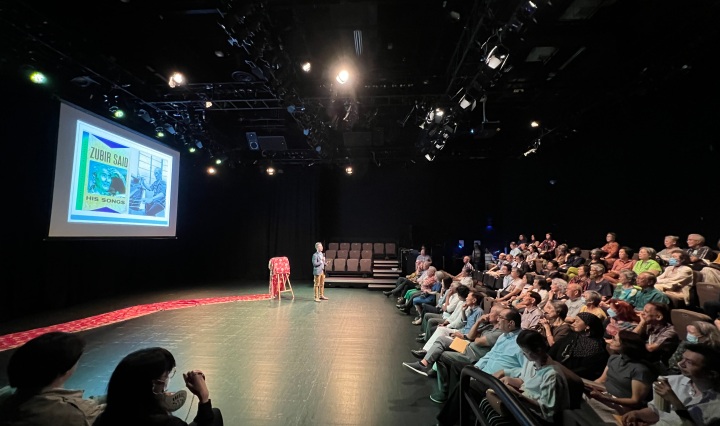
Zubir Said: His Songs

July 3, 2009 · 8 Comments

"Zubir Said: His Songs"

"Zubir Said: His Songs"

Everyone loves the romance of discovering a long-lost person or item but I’ve always felt that we should be proactive in our documentation and archiving initiatives. Do it! before too much is forgotten or lost.

Our intent to trace and publish the music of notable Singaporean composers dates back to 1982 but work did not really start till around 1987.  I managed to publish a book about our national anthem composer, Zubir Said but did not succeed in publishing the music of the late Charles Lazaroo and Tsao Chieh.

With support from the Singapore Cultural Foundation, we approached Berita Harian to sponsor the Zubir Said book project in 1987. Former Editor, Berita Harian Zainul Abidin Rasheed (who is now Minister of State for Foreign Affairs) who was then a member of the Foundation’s Management Committee, agreed to support the project, setting us on our way. Not only did Berita Harian support the project with cash, they also extended the services of their Deputy Editor Hawazi Daipi and journalist Mardiana Abu Bakar.

Hawazi and I co-chaired the Zubir Said Project Committee and we roped in musicians the late Ahmad Jafaar and Joseph Peters, Mrs Toh-Chua Foo Yong (Singapore Broadcasting Corporation) and representatives from the Oral History Department and National Archives.  We each had our respective roles to play– The musicians would research, select and score the songs of the composer while Oral History’s Dr Daniel Chew would write the story of the National Anthem.  Hawazi chaired the Editorial Committee while Puan Sri Datin Dr Rohana Zubir-Hamid, the daughter of Park Zubir would pen a chapter on her father. I had the pleasure of pulling the project together.

Before we started the project, we visited Pak Zubir in his home in Joo Chiat Place to pay him our respects.  Hawazi wisely advised that we should seek Pak Zubir and Puan Tarminah’s blessings for the project first.  When we shared our plans with Pak Zubir, he expressed his thanks quietly, adding that he did not believe that a day would dawn when Government would recognise him by publishing his songs.  He gave us his blessings for the project.  Regrettably, he did not live to see the completion of the project as he died at the age of 80 years in Nov 1987, about six months after our visit and three years before the book launch.  I felt sad about his demise and hoped that learning about our plan brought him some contentment and happiness in his final months.  I was also grateful that we managed to see him and receive his blessings.

Our two-and-a-half year search including appeals to the public for tapes and records, yielded over 118 songs and we selected 45 for publication. Daniel interviewed Dr Toh Chin Chye, Mr Lee Khoon Choy, Mr Paul Abisheganaden and Yap Yan Hong, the former Superintendent of the Victoria Theatre to piece together the story of the National Anthem.

“Zubir Said: His Songs” was launched on 3 March 1990 by Minister of State for Community Development Dr Seet Ai Mee. With the help of Pak Zubir’s prize student Iskander Ismail, we arranged for veteran singer Kartina Dahari to sing his song “Sayang di Sayang” at the launch.  Her rendering of the song together with Rohana’s heartfelt tribute to her father, brought many tears to the eyes of family and friends present.  A Zubir Said Scholarship Fund was also launched during the Ceremony for the benefit of young musicians.


Invite to the launch of "Zubir Said"His Songs"

Invite to the launch of "Zubir Said"His Songs"

Rohana lived in Kuala Lumpur and I updated her on the project whenever she visited her family.  Upon her father’s demise, Rohana offered to donate her father’s personal effects to our National Museum (his attire, pipe, anklong sets, medals) if there was intent to create a Zubir Said Gallery.   Unfortunately, the National Museum was not ready to give such a commitment but in the hope that this would come to fruition in the near future, I secured funds from the Foundation to purchase a new piano for the family in exchange for Pak Zubir’s piano.  The piano was hoisted out of the window of the second level flat as the stairs were too narrow, and brought to the Museum store. Years later when I was working on the Esplanade, I enquired about the piano hoping to place it in a “Zubir Said Studio”.  I was told that piano was in disrepair. 

I sometimes wonder what became of Pak Zubir’s personal belongings.  I hope somehow, they find their way back to our Malay Heritage Museum or National Museum.

→ 8 CommentsCategories: Ministry of Community Development (1985 to 1990)
Tagged: , , , , , , , ,

visual arts in the esplanade

July 1, 2009 · Leave a Comment

On 16 November 2008, I organised a tour of the artworks in the stations of our Northeast Line.  It is so wonderful how art has been integrated into the walls and floors of the stations and I so admire LTA Project Architect Andrew Mead for his great success in this endeavour. Unfortunately, we could not do for the Esplanade what he did for the NEL stations.

Art-in-Transit Tour by Andrew Mead

Art-in-Transit Tour by Andrew Mead


Brother Joseph McNally, supported by a band of architects, lobbied for a modern art gallery in The Esplanade.  They felt that visual artists had been short-changed as St Joseph’s Institution was not suitable for a modern art gallery partly because its ceilings were too low.  I had secured SJI and the Catholic High School buildings for the museum in the late-80s, arguing that SJI itself  was six times larger than the 800 sqm National Museum Arts Gallery in the old National Museum which was due for renovation.  

Their request came to nought as we were too pre-occupied with the needs of the perfoming arts.  Still, I aspired to integrate art into the structure of the Esplanade – its walls, waterfront floor tiles, bathroom tiles. I had seen this done in art centres in Australia where visual artists had a role in the development of a performing arts centre. I initiated a Visual Arts Advisory Panel in 1994 comprising Connie Sheares, Eng Seok Chee, Susie Koay and other curators. We spent a few afternoons talking to artists to identify suitable ones. Although the report was approved by the Steering Committee, it was not implemented after I left the Company in 1997 due to financial constraints.

Han Sai Por showing off a marquette of "Seeds"

Han Sai Por showing off a marquette of "Seeds"

Nonetheless, we did acquire a few pieces of performing arts-related artworks – “In Sync” by Sandy Wong and Ming Wong’s “Before the Opera”. Singapore Technology Automative (STA) offered to donate a collection of four sculptures “Seeds” by Han Sai Por to the Esplanade on the occasion of its 25th anniversary in 1996. The works were unveiled in October 1996. Han’s “Seeds” are now displayed at four corners of the Esplanade waterfront garden whereas I had envisioned them in a cluster “rolling off” the side of a grassy slope.

Late Singaporean calligrapher, Pan Shou also dedicated a classical Tang style poem to the Esplanade. On 19 May 1996, he presented the calligraphy to Minister George Yeo at an exhibition at the National Museum.  The calligraphy was to be cast in stone and placed in a public location when the centre opened.  

With family of Pan Shou at Presentation Ceremony, National Museum

With family of Pan Shou at Presentation Ceremony, National Museum


The Esplanade management is supporting visual artists by staging rotational exhibitions in the Main Concourse and in the Jendela, a gallery which was carved out of part of the Concert Hall.  The suspension of three-dimensional art pieces in the series of light cones above what we nicknamed “Theatre Street” of shops, is a surprisingly nice touch.

Art suspended within light cone above "Theatre Street"

Art suspended within light cone above "Theatre Street"

→ Leave a CommentCategories: Esplanade Theatres · Ministry of Information & the Arts (MITA) (1990 -1992) · Singapore Arts Centre (1992 to 1997)
Tagged: , , , , , ,

singapore cultural foundation – sponsorship for the arts

July 1, 2009 · 4 Comments

When the National Arts Council was formed in 1991, its start-up funds were drawn from its predecessors – the Ministry’s Cultural Affairs Division, the Singapore Cultural Foundation and the National Theatre Trust. 

The Singapore Cultural Foundation was mooted in 1978 by then Minister for Culture the late Ong Teng Cheong whom I credit for having put into place all the essential buildings blocks for arts development – from arts showcases (at least six festivals) to awards for (Cultural Medallion)  artists and sponsors (Patron of the Arts Awards).

Rationale for Singapore Cultural Foundation logo

Rationale for Singapore Cultural Foundation logo

The Singapore Cultural Foundation was the fund-raising arm for the arts, a repository for tax-exempt donations from individuals and corporate organizations.  By the time I joined the Ministry of Culture in April 1981, the Foundation had raised about $4 million and grants made to a handful of artists.  While the Foundation’s Fund-raising Committee focused on fund-raising, my role was to develop the donation programme, to demonstrate its worth as quickly as possible, to honour our obligations to our pioneering sponsors and attract more donations.

I got approval from Lee Wai Kok, former Deputy Secretary (Culture), to engage a full-time Executive Officer to staff the secretariat of the Foundation.  Rosni Othman who now works with the Singapore Dance Theatre, was recruited.  As it was difficult to get new posts from Ministry of Finance and not wanting to waste energy trying, we decided to engage Rosni from the Foundation’s financial resources. She was succeeded by Elaine Tan who is now a Director in NAC.

We convened quarterly Management Committee meetings chaired by the Ministry’s Permanent Secretary (Cheng Tong Fatt, Wong Hung Khim, Koh Cher Siang) to decide on the grants.  Synergizing its funding policy with the Ministry’s Cultural Affairs Division, we introduced a system of four (quarterly) funding cycles a year to deal with requests and proactively sought out areas and projects to support rather than wait or merely react.  We devised a series of grant schemes in an effort to give the work some shape, introduced scholarships awards including one for disabled artists; and extended seed grants to new arts initiatives like the National Library’s Arts Resource Centre (now the Performing Arts Library at The Esplanade) and Singapore International Jazz Festival.  This earned us the accolade “Playing fairy godmother to the arts” in a Straits Times article written by Judith Holmberg on 9 Dec 1987.  

First (catch-up) Annual Report of Singapore Cultural Foundation

First (catch-up) Annual Report of Singapore Cultural Foundation

We also staged events twice yearly to honour our benefactors and present awards to artists   We published our very first annual report in 1983, unveiling our committee composition, our beneficiaries, our Constitution and donations received. We caught up with the back-log and the first report contained a super-long list of sponsors and, beneficiaries.  For our first sponsors’ event, I used Chng Seok Tin’s work ‘Melody on the Moor‘ on the cover of the programme sheet. Seok was away in Mexico having got the Foundation grant to study overseas and I visited her family in Haig Road, to secure permission to use her work.  I also invited writer Maria P Tan, another grant recipient, to enact her latest short story. The event turned out to be quite pleasant and kicked off a series of twice-a year ceremonial events.

Recognizing that donors might have preferences, we set up special accounts for specific causes or arts groups. At first, there was resistance owing to the concern that such an option would erode support for the Endowment Fund. I argued that the Endoment Fund was stagnating and we needed to energize the fund-raising effort.  In any case, funds would not have flowed in, if not for the special accounts.  The scheme proceeded and we received a fresh flow of donations, for Singapore Dance Theatre, the Singapore Festival of Arts, American Artists programmes, SIA Great performers’ series and other favourite causes.  The “Scholarships for Disabled Artists” account was set up for Hi! Theatre, kicking off with a dinner hosted by Goodwood Hotel and featuring a Hi! Theatre performance.  The NAC inherited these special accounts and still operating some of them today.

The Foundation also published “Singapore Artists”, the first-ever coffee table book  featuring 68 Singapore visual artists and; “Zubir Said: His Songs” featuring the life story and songs of our National Anthem composer; and the story of how “Majulah Singapura” came to be chosen as Singapore’s National Anthem.

I served as Secretary of the Foundation’s Management Committee for a period of nine years from 1981 to 1990 when I was posted to the Ministry of Communications and Information.

P1000601

Annual Reports of Singapore Cultural Foundation


→ 4 CommentsCategories: Ministry of Community Development (1985 to 1990) · Ministry of Culture (1981 to 1984) · Ministry of Information & the Arts (MITA) (1990 -1992)
Tagged: , , , ,

arts housing scheme – $10 a classroom a month

May 24, 2009 · Leave a Comment

In the early 1980s, I recall a Finance Ministry official asking me why artists needed space when they had theatres and my reply that before every performance in a theatre, 6 to 9 months of preparatory work go on, invisible to the public eye, in the homes of artists and other found places.  I tried to explain that arts groups needed rehearsal spaces, offices, workshops and storage space.

I couldn’t have been very convincing as the Ministry later shut the case on the Ministry of Culture’s proposal to restore the Singapore Staff Command College building on Fort Canning into an arts centre. The building which had served as the British Far East Command Centre during WW2 had stood vacant for many years except for the bats that nested there.  It later housed the Fort Canning Club and now Legends Club.

It was this conversation and several incidents in the mid-1980s that inspired the Arts Housing Scheme which I hatched in 1985.  In 1983 and 1985, we conducted surveys on the housing arrangements for arts groups and found that except for groups which were aligned to clan associations or churches, the majority were “nomadic” in nature.  They held their rehearsals in the homes of Committee members, at the now demolished Drama Centre’s “Practice Rooms A & B” (where the new Annexe of the National Museum now stands), in school halls and community centres, as and when they were available and the groups could afford it.

Around that time too, textile artist Eng Tow approached me to enquire about the availability of space for artist studios.  She shared that in England where she had trained at St Martin’s, the Arts Council had arts studios for rent to artists.   Kuo Pao Kun also approached me for financial assistance towards the repairs on the Practice Performing Arts School premises in Upper Serangoon Road.  These enquiries pointed to a gap in arts development services which was of marginal interest as we were pre-occupied with the organization of arts events.

In 1985, I was sent to West Berlin to attend a Seminar on Cultural Administration organized by the Goethe Institut.  There, I saw a railway station and other old buildings converted into arts spaces.  This was also the case in Australia which I toured in 1988 – Gormon House in Canberra, Victoria Meat Market in Melbourne, Gertrude Street in Sydney and many others.

Every quarter,  the Land Office circulated a list of disused Government buildings, mostly disused schools to all ministries.  The organisations which normally responded to the offer were the charitable service organizations.  It dawned on me that the arts were as needy as these charitable groups but not knowing whether our requests would be well received,  I invited Mr S Rajaratnam of the Land Office for a chat.   He was kind enough to come over to my office at City Hall and after sharing with him about “Cultural Vision 1999”, our conversation went something like this:  Juliana: “Mr Raja, we desperately need buildings for the arts”.  Mr Raja: “No one ever told me this before”.  Juliana: “I’m telling you now!” From that day onwards, Mr Raja became my best ally for arts development.   He sent us a seemingly endless supply of buildings.

The first building, the Telok Ayer Primary School (which we renamed ”Telok Ayer Performing Arts Centre (TAPAC)”) in Cecil Street was offered to us with the expectation that it would be demolished within five years. The school was vacated in November 1984 and by January 1985, it had re-opened as an arts centre, housing St*ars (led by Roger Jenkins and Maria Wheeler), Chinese Theatre Circle, Singapore Amateur Players, National Theatre Trust affiliates, the National Dance Company and Third Stage. I remember exhorting the groups not to worry over its appearance. “The structure is sound and we have light and water”, I said, “Just move in!”  The groups paid a rental of $10 a classroom a month in addition to which they bore all utilities and conservancy charges.  They were also expected to form a management committee to self-manage the premises.

The next building offered to us was the very charming 26, Cairnhill Road which I later learnt, housed the former ACS Primary School. I remember surveying the three–storey building from the courtyard, with Tisa and Irene Wong.  We felt slightly unnerved by the signs of abandonment – broken window panes and the stench of urine, etc as we made our way to the upper floors together.  As the building had been vacant for too long and we did not have funds to restore it, the only group that was brave enough to accept our offer, was Act 3 led by Ruby Lim-Yang, Jasmin Samat and R Chandran.  They confined themselves to the school hall one level below the main building.  Having  committed themselves to the challenge of proving that their venture could be profitable, they chose to remain a “private limited” company and paid a commercial rental besides raising funds to restore and fit out the space to their needs.  They proved their case over the years and I have such great respect for all three of them.

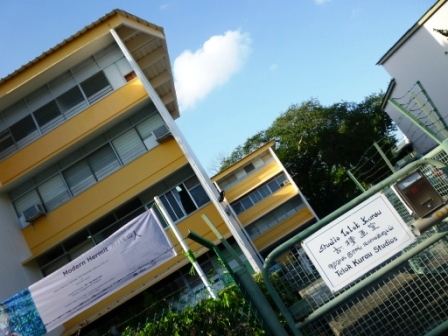
The third building was the Stamford Arts Centre on Waterloo Street, opposite the Kuan Imm temple.  Mr Raja warned me that it would be available only for 3 years as there were plans to widen the road.  I decided to accept it anyway and the groups that moved in included Bhaskar’s and Practice Performing Arts Centre.   The Telok Kurau East School on Telok Kurau, Lorong J was next secured for the St Patrick’s Arts Centre which was still morphing into the La Salle School of the Arts.  Since La Salle vacated it, it has become a visual arts centre housing notable artists like Tan Swie Hian, Teo Eng Seng, the late Anthony Poon, Chng Seok Tin and many others.

By far the most famous building under the Arts Housing Scheme is the Substation. This old power station had lain vacant for about 6 years. Desperate to find more buildings, we decided to check out every prospect, no matter how unlikely a candidate a building looked. From the exterior, the red-brick building looked unfriendly, like a fortress, quite unlike the more open school buildings we had secured.  I remember climbing up a vertical steel ladder on the left rear of the building, sliding open a huge door to land on a concrete floor with a few holes punctuated into a basement.  I learnt later that this was where the generator was housed.  

I wasn’t optimistic about its prospects given its relatively derelict state but emboldened by Tisa’s optimism, we decided to invite concepts from several arts groups.  An article “PUB station turns arts centre” written by Leong Weng Kam was published on 30 Sep 86 in the Straits Times revealed that two groups submitted good proposals but we eventually awarded it to Kuo Pao Kun who transcended the immediate needs of his own theatre group, to pioneer the concept of an inclusive, multi-disciplinary arts centre.  The Substation was the first art housing to receive a renovation grant as it would not have been possible for any of the arts groups to fund the project from their own limited resources.  The building was enhanced.  The art gallery was a car porch into which a large vehicle would have backed and the dance studio was built on the flat rooftop.

The groups that were fortunate enough to secure the space shared that within  a year,  their output tripled as they had the luxury of rehearsal space that they could use whenever they needed and at minimal costs. 

The Arts Housing Scheme has grown over the years, stretching  into Perumal Road and Kerbau Road in Little India,  parts of China Town, community centres, libraries and more recently, decanted space in new or retrofitted office buildings.   When I look back, I am so glad I did not reject Telok Ayer or Stamford schools.  They have served as worthy arts housing spaces for over 20 years, way in excess of the 3-5 years expected!   It is pure joy for me, to walk into the compounds of TAPAC and Stamford Art Centre and be enveloped by the cacophonic strains of  ethnic music, mixed with the voices of actors emanating from these acoustically-untreated buildings!

→ Leave a CommentCategories: Arts & Heritage in Historic Buildings · Ministry of Community Development (1985 to 1990) · Ministry of Culture (1981 to 1984)
Tagged: , , , , , , ,